
Post-Hail Inspection: What Survives on a Sasquatch Hangerless System vs. Traditional Gutter Guards
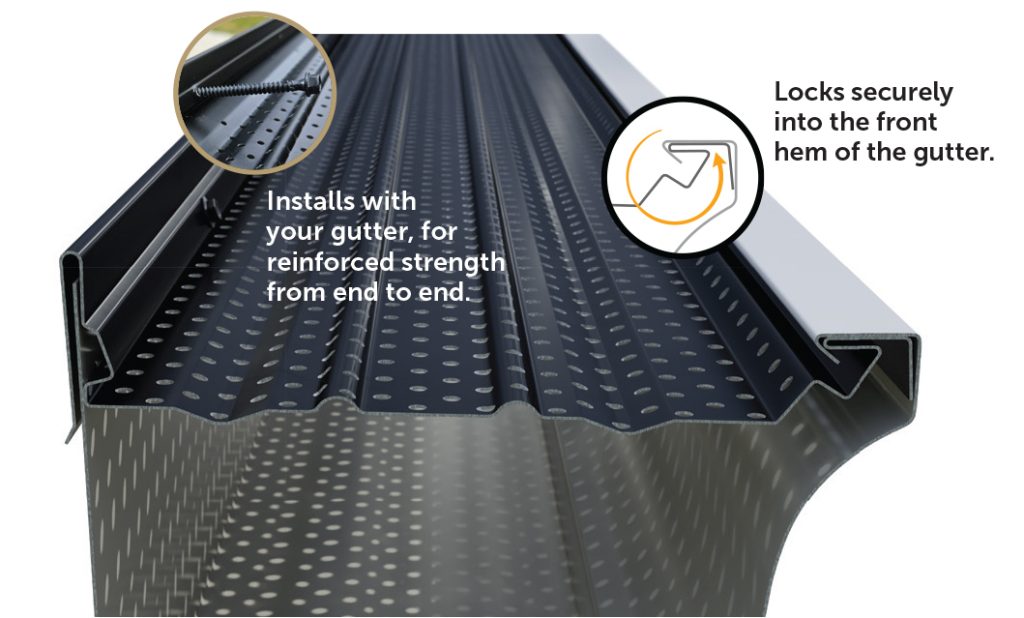
Every named Texas hail event triggers a post-event inspection cycle across commercial property portfolios. On a portfolio with mixed gutter-protection product across locations — the reality on most portfolios that grew through acquisitions — the inspection reveals a meaningful failure-mode difference between hangerless systems and traditional hanger-mounted guards.
The traditional guard failure signature
Traditional gutter guards mount to the existing gutter hangers or introduce their own drilled attachment points. On post-hail inspection, the failure modes documented across Texas portfolios include (Insurance Information Institute):
- Guard-to-hanger connection lift. Hail impact combined with wind uplift separates the guard from the hanger. The guard is intact but no longer covering; debris enters the gutter freely until the guard is refastened.
- Sagging between hangers. Repeated impact deforms guards that rely on hanger spacing for structural support. The guard now sits below the front hem of the gutter and traps water on top.
- Screen tearing. Fine-mesh screens on top of some traditional guard styles tear under direct hail impact, especially in 1.5″+ stone events. The mesh fails locally; the underlying guard may still function.
- Sectional gap opening. Between-section joints on some traditional guards open under thermal cycling accelerated by post-event heat. Water sheets over the gap during the next rain event.
Each of these failure modes is repairable, but each is also a callback trip — a maintenance vendor scheduling visit, a lift day if the roof edge is elevated, and a labor line item on the post-event budget.
The Sasquatch hangerless survival pattern
The Sasquatch hangerless design eliminates the guard-to-hanger connection because there is no such connection (E-Z Gutter Guard). The base .019″ aluminum locks into the gutter front hem and screws into the fascia through the rear ledge. Post-hail inspection on Sasquatch-protected properties across Texas typically shows:
- Front-hem lock intact. The lock geometry does not release under hail impact plus wind. There is no separation event to inspect for.
- Fascia screw ledge holding. The rear screw fixes into structural fascia; hail impact does not translate into a pullout force at the fastener.
- Aluminum surface dents on direct large-stone impact. On 2″+ stone events, the aluminum surface can dent visibly. Function is not compromised; the dent is a cosmetic finding, not a repair line item.
- .022″ Arctic Extreme upgrade tolerating larger stones. The heavy-duty specification tolerates larger stone events without visible surface damage — the specification difference is documented against the base .019″ performance.
The four-item inspection checklist
Regardless of guard type, the post-hail inspection template that satisfies underwriters and property insurance carriers has four items:
- Attachment integrity. Every fastener or hanger connection, dated photo. On Sasquatch this reduces to fascia-screw ledge inspection; on traditional guards this expands to every hanger attachment.
- Surface condition. Cosmetic hail impact marks documented with scale reference (coin or ruler). Distinguishes cosmetic finding from functional failure.
- Flow test. A rinse test at the downspout after inspection confirms water reaches the discharge point without pooling above the guard.
- Warranty-file entry. The dated inspection report goes on the maintenance file — on Sasquatch the transferable lifetime limited warranty documentation is referenced (NOAA Storm Prediction Center).
Sequencing the post-event walk
Portfolio-scale inspection cycles benefit from a repeatable sequence: identify affected locations by NOAA storm reports and property zip codes, dispatch inspectors within 30 days, capture the four-item checklist per location, and roll the findings into a single portfolio report before the insurance broker asks for one. That order matters — a broker who receives an unsolicited, structured portfolio inspection report signals maturity to the underwriter on the next renewal.
What the survival difference means for portfolio specification
On a Texas commercial portfolio that sees named hail events regularly, the specification decision is not just about product cost or install cost. It is also about the expected post-event callback labor over the portfolio lifespan. Hangerless systems reduce the callback rate on hail events because the failure modes that drive callbacks on traditional guards are eliminated by design. Over a 10-year hold period on a 20-location portfolio, that callback avoidance is a documented budget line, not a marketing claim.
Where CCSI fits
Construction Component Sales Inc. represents Sasquatch into Texas commercial and multi-location portfolios. On a post-hail inspection cycle, that means the inspection template, warranty documentation, and any specification upgrade recommendation arrive as a coordinated post-event package the property manager can hand to the insurance broker. See the full CCSI E-Z Gutter Guard product line.
Frequently asked questions
Does hail damage void the Sasquatch warranty?
The lifetime limited transferable warranty covers manufacturing defects. Cosmetic hail damage on the aluminum surface is a documented finding, not a warranty claim. Function-affecting damage is inspected against the warranty terms on a case-by-case basis.
Should the specification default to .022-inch Arctic Extreme for Texas hail zones?
For properties in North Texas, the I-35 corridor, and the Panhandle where hail exposure is documented in NOAA storm records, the Arctic Extreme specification is the defensible default. For Coastal and East Texas with lower hail exposure, the standard .019-inch specification is typically sufficient.
How often should Texas commercial properties inspect post-hail?
Within 30 days of any named event with 1-inch or larger stones documented at the property zip code. The inspection date should be recorded on the maintenance file to support any future insurance claim.
Do traditional guards get replaced or repaired after significant hail damage?
Depends on failure mode. Connection lift is typically re-fastened. Sagging is typically replaced. Screen tearing is typically replaced. Sectional gap opening is typically replaced. The repair-vs-replace decision drives most post-event callback budgets.
Looking for a product or a quote?
Tell us about your project and we'll help you source the right building product.