
Checking Wildfire Risk Before You Spec Gutter Protection: TxWRAP and IBHS Guidance for Texas Commercial Properties
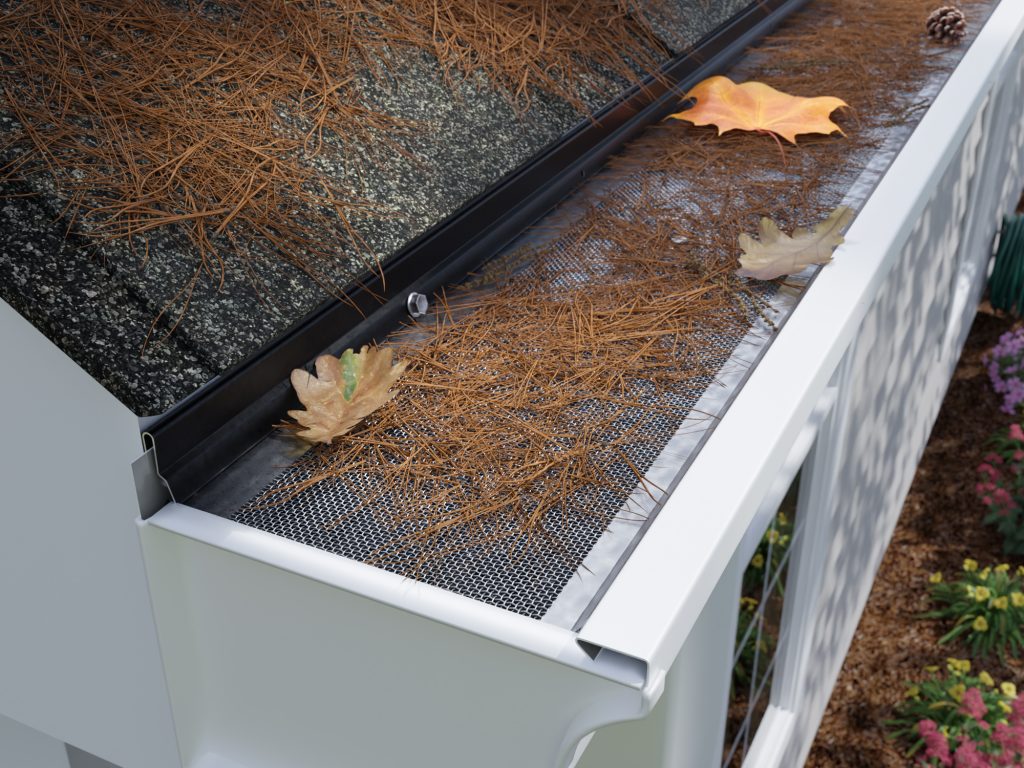
Dry leaves and needles in a gutter are a fire hazard as well as a clog. When embers land in a packed gutter, that debris can ignite right at the roof edge, next to fascia, soffits, and roofing. For Texas property managers with buildings near grassland, brush, or wooded areas, gutters belong on the wildfire checklist.
The question is where to start. A portfolio may include dozens of buildings, and not all of them face the same exposure. This post covers two free resources that help answer that question, the Texas A&M Forest Service's wildfire risk portal and the Insurance Institute for Business & Home Safety's gutter guidance, and how Sasquatch fits in.
Step one: check the property's wildfire risk
The Texas A&M Forest Service runs the Texas Wildfire Risk Assessment Portal, known as TxWRAP. It is a free statewide planning tool with maps, reports, and statistics. Its main application, the Texas Wildfire Risk Explorer, lets anyone look up an address.
Several Risk Explorer layers are useful for commercial properties:
- Wildland urban interface (WUI). Shows how land near buildings is classified for wildfire mitigation.
- Sources of ember load to buildings. A relative index of how likely nearby fuel is to produce embers that land where buildings are, if a fire occurs. The Forest Service notes this layer is useful for prioritizing actions to reduce ember damage.
- Surface fuels and fire intensity. Show what vegetation is nearby and where dangerous fire behavior is possible.
The Risk Explorer also includes a "What's Your Risk" tool. According to the TxWRAP portal, it is meant to inform homeowners and business owners about wildfire risk near their location based on surrounding conditions.
Use it to rank buildings
A property manager can look up each building, note the WUI and ember-load results, and sort the list. Buildings with high ember exposure and heavy tree cover over the roof edge move to the top. Buildings in dense urban cores with little vegetation nearby move down.
Step two: compare the roof edge to IBHS guidance
The Insurance Institute for Business & Home Safety (IBHS) studies how buildings fail in disasters. Its wildfire guidance is written mainly for homes, but the roof-edge advice applies to any building with gutters.
The IBHS Wildfire Ready critical prep guide calls roofs, vents, gutters, and siding weak points where embers can enter or build up. It recommends regularly clearing gutters and downspouts of vegetative debris and replacing plastic or PVC gutters with noncombustible metal options such as aluminum or steel.
IBHS goes further in its wildfire-resistant construction codes supplement. Its model language says gutters and downspouts shall be noncombustible, and gutters shall be covered with a noncombustible material to prevent debris from accumulating inside.
That gives a practical three-question check for each high-priority building:
- Are the gutters and downspouts metal?
- Are they clear of leaves and needles today?
- Is there a noncombustible cover keeping debris out between cleanings?
Where Sasquatch fits
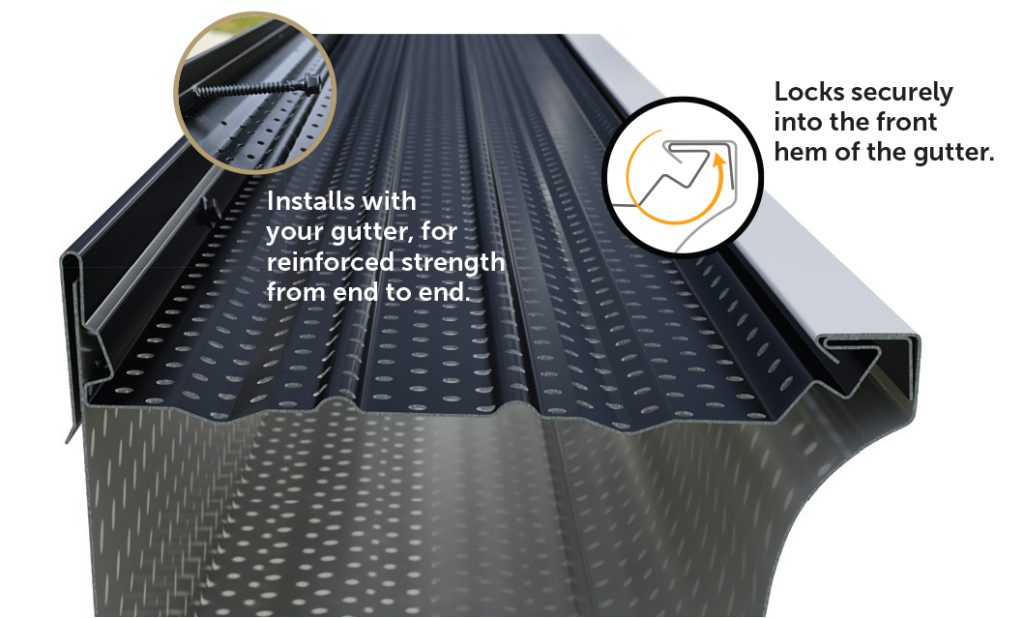
Sasquatch is E-Z Gutter Guard's hangerless gutter protection system. It is a cover, not a gutter and not an installation service. According to the Sasquatch installation guide, it is installed at ground level together with the gutter: it locks into the gutter's front hem, screws are pre-started through a patent-pending rear screw ledge, and the assembly fastens directly to the fascia.
Sasquatch is perforated, painted aluminum, available in black, in 5-inch and 6-inch widths and 7.5-foot lengths, with a .019-inch standard gauge or .022-inch Arctic Extreme. Roofing Contractor reports that it meets ASTM E2768 for fire resistance and, with the optional Fine Debris Filter, ASTM E2886 for ember intrusion. It carries a lifetime limited transferable warranty. Details are on the E-Z Gutter Guard Sasquatch page.
Because Sasquatch goes on with the gutter, it fits best when gutters are being replaced or newly installed. That lines up with the three-question check: a property replacing plastic or worn gutters with new metal gutters can add a metal cover in the same job. It does not remove the need to inspect roofs, gutters, and cover surfaces.
What a cover does not do
Gutter protection is one piece of a larger plan. IBHS also stresses keeping roofs clear of debris, using ember-resistant vents, and keeping the first five feet around a building free of combustible materials. A cover reduces debris inside the gutter. It does not make a building fire-resistant, and it does not replace defensible space, roof maintenance, or local fire-code requirements.
Timing the work
Fall leaf drop is a natural time to walk priority buildings, since gutters are filling and debris is easy to see. Pair that walk with the TxWRAP ranking, and schedule gutter replacements on the highest-exposure buildings first, adding a cover at the same time. Check current burn bans and fire conditions through the Texas A&M Forest Service before planning roof work during dry periods.
Putting it together
- Look up each property in TxWRAP and rank by WUI and ember-load exposure.
- Walk the top-ranked buildings and answer the three IBHS gutter questions.
- Clear existing debris now, and when gutters are replaced, pair new metal gutters with metal gutter protection where trees overhang the roof edge.
- Record the work so insurers, boards, and future managers can see what was done.
CCSI supplies Sasquatch for Texas commercial, multifamily, and HOA properties. See the CCSI E-Z Gutter Guard line or start on the CCSI homepage.
Frequently asked questions
What is TxWRAP?
The Texas Wildfire Risk Assessment Portal, a free statewide tool from the Texas A&M Forest Service with maps and reports, including the Texas Wildfire Risk Explorer address lookup.
What does IBHS recommend for gutters in wildfire areas?
IBHS recommends noncombustible metal gutters and downspouts kept clear of debris. Its model construction language also calls for covering gutters with a noncombustible material.
Is Sasquatch a gutter or an installer?
Neither. Sasquatch is E-Z Gutter Guard's hangerless gutter protection system, an aluminum cover installed together with the gutter at ground level before the gutter is hung.
Does gutter protection make a building fire-resistant?
No. It reduces debris inside the gutter. Roof maintenance, ember-resistant vents, defensible space, and local fire codes still apply.
Looking for a product or a quote?
Tell us about your project and we'll help you source the right building product.